
Have you ever wondered how your favorite local brands actually get onto the big screen without spending a fortune? I’ve seen many business owners assume these spots are only for giants like Coca-Cola or Nike. It is exciting to see how much the digital landscape has changed for smaller players lately.
I want to share real streaming tv advertising examples that prove you don’t need a massive budget to win. We will skip the dry theory and look at how ctv advertising works for companies spending between $10,000 and $200,000 monthly. These are proven results from people just like you.
You’ll see the exact strategies these brands use to build trust and find new customers today. I am sharing five different industry looks to help you find a path that fits your goals and budget constraints. Success usually leaves a trail of clues we can follow together.
By looking at real ctv advertising data, you can stop guessing and start reaching the right viewers with total precision. Making smart choices can turn a simple 15-second video into a high-growth engine. This approach saves money while maximizing your impact in a crowded market.
Key Takeaways
- Review real campaign data from monthly budgets ranging from $10,000 to $200,000.
- Explore five industry-specific approaches that match different small business models.
- Learn to distinguish between high-performing ads and those that waste your budget.
- Compare various ad formats including 15-second pre-rolls and interactive shoppable options.
- Understand the actual CPM costs for premium inventory versus budget-friendly channels.
- Identify the specific signals that tell you if your business is ready for this channel.
What CTV Ads Are and How They Work
Ever noticed how those 15-second spots on Hulu feel exactly like old-school TV ads but run on your smart TV apps instead? I call these ctv ads, and they are the secret weapon for small businesses today. Essentially, these are video commercials that play while you are streaming your favorite movies or shows on a television connected to the internet.
The magic happens on devices like Roku, Fire TV, or your Apple TV. Unlike social media, where a viewer might scroll past your hard work, these ads are usually non-skippable and full-screen. This means viewers actually see and hear your message from start to finish without distractions.
You can find your brand on major platforms like Peacock, Tubi, or Disney+. Since these ads play during high-quality content, they carry the prestige of traditional television. However, they offer much better targeting than old broadcast channels ever could.
“The transition to digital television is not just a change in technology, but a total shift in how we connect with people in their living rooms.”
Most campaigns run on a CPM basis, which stands for cost per thousand impressions. You can expect to pay different rates depending on which platforms you choose. Some even allow interactive features like QR codes, turning a living room viewers‘ experience into a website visit instantly.
| Inventory Type | Average CPM | Targeting Depth |
|---|---|---|
| FAST (Free Apps) | $12 – $20 | Basic Location |
| Standard Tier | $20 – $35 | Interests & Behavior |
| Premium (Hulu/Disney+) | $35 – $55+ | First-Party Data |
I love this format because it fits any budget. You can target specific households based on their location, interests, and viewing behavior. This ensures your streaming budget is never wasted on people who aren’t interested in your services.
CTV Ad Formats You Need to Know
When I first started exploring streaming, I was surprised by how many different ways viewers actually interact with ctv ads. It is not just about a simple video playing during a break anymore.
Understanding these different styles helps you pick the right one for your budget. If you want to see the full benefits of connected TV advertising, you need a format that fits your specific business goals.
Pre-Roll Ads
These spots play right before your chosen show or movie starts. I often see these on free platforms like Tubi or Pluto TV. They capture high attention because people are excited to start their content.
Since people are eager to watch their show, keep these spots short. I recommend using 15-second ads for this format. This ensures you deliver your message before the audience loses patience.
Mid-Roll Ads
Mid-roll spots run during natural breaks in the middle of a program. This is the most common format you will see. It feels very similar to the traditional television experience we all grew up with.
Most viewers are already deeply invested in their show by the time these play. Because of this, completion rates often exceed 95% for this type of content. Most of these ads are non-skippable, which means your message actually gets heard.
Post-Roll Ads
These play once the show or movie has completely finished. In my experience, this is the least effective way to reach people. Most viewers are already reaching for the remote to turn off the TV.
They might be deciding what to watch next and will likely ignore your message. Use this format only if you have extra budget to test different placements.
Interactive and Shoppable Formats
Interactive ctv ads are a personal favorite because they encourage action. You can include QR codes that people scan with their phones to visit your website. This provides a direct path from the living room to your online store.
Early data shows that these formats lead to 3-5x higher engagement than standard video. This high level of engagement makes them perfect for small businesses. They help you track exactly who is responding to your brand.
Home Screen and Native Placements
These ads appear on the home screen of devices like Roku or Fire TV. They catch people while they are still browsing for something to watch. This is known as the “discovery moment.”
It is a great way to build awareness before a user even picks a show. Native placements look like a part of the menu itself. This makes them feel less intrusive and more like a helpful suggestion.
Streaming TV Advertising Examples by Industry
I’m showing you five real advertising examples from companies spending various amounts so you can find a campaign model that matches your budget and goals. It is often hard to imagine how your own small business fits into the world of television. These advertising examples demonstrate that success does not require a million-dollar budget or a global marketing team.
I want to break down how different brands use these tools to drive real growth. You will see that the strategy changes based on what you sell and who you want to reach. Each of these examples highlights a specific way to use streaming to your advantage.
Whether you run a local shop or a growing online store, there is a path here for you. We will look at real data, actual spending, and the results these campaigns generated. This perspective helps demystify the process and makes it feel much more achievable.
DTC and Ecommerce Campaign Example
I watched a direct-to-consumer mattress company spend $30,000 monthly to grow its online presence. They did not try to reach everyone in the country at once. Instead, they ran 30-second product demo spots on platforms like Hulu, Peacock, and Tubi. They focused their targeting on adults aged 25 to 54 in the top 20 metropolitan areas.
They used behavioral data to find people interested in home furnishings and those who had recently moved. Their creative work was simple but effective, ending with a unique tracking URL for the viewers. This allowed them to see exactly who moved from their TV to their website. They also used retargeting to show display ads to households within 48 hours of seeing the TV spot.
The performance results were impressive for a mid-sized budget. They achieved a completion rate of over 90%, meaning almost everyone watched the whole ad. They saw a 15-25% lift in branded search, proving that people were actively looking for the brand after seeing the ad. With a CPM between $18 and $30, they found a sustainable way to scale their sales.
B2B Account-Based Campaign Example
A B2B cybersecurity firm used $15,000 monthly to reach decision-makers at 400 specific enterprise accounts. They did not use generic product demos that you might see on local news. Instead, they focused on messaging built around thought leadership and industry trust. This approach helps build credibility before a sales person ever makes the first call.
They matched their target account list to employee households using smart IP-based tracking. This allowed them to show ads only to people who actually worked at those 400 companies. They also applied filters for organizations with over 1,000 employees in the financial and healthcare sectors. This example shows how precision can save a lot of money in advertising.
The campaign ran 15 and 30-second spots on premium inventory where business leaders spend their time. Their results showed a measurable lift in visits to their site from those specific target accounts. The CPM stayed between $30 and $45, which is excellent for such a narrow audience. It proved that ctv campaigns are not just for selling soap or cars; they are powerful tools for complex business deals.
They also monitored how often employees from the target list engaged with their online content. This level of detail helps marketing teams align perfectly with what the sales team needs. It turns “cold” outreach into “warm” conversations because the prospect already recognizes the brand name. You can influence the entire sales pipeline without wasting a single dollar on the wrong viewers.
Local and Regional Business Example
A regional hospital network spent $10,000 monthly to build brand preference across a three-state area. They chose to run 30-second spots on FAST channels and Peacock. Their geographic targeting was very tight, focusing only on the zip codes near their facilities. They reached adults aged 35 to 65 who showed an interest in health and wellness topics.
Their creative featured real patient testimonials, which felt much more personal than a standard commercial. They maintained a frequency of 4 to 6 impressions per household every month. This consistency helped them stay top-of-mind for families making healthcare decisions. For a local campaign, this steady presence is more important than a one-time big splash.
The results were quite strong for a relatively small investment. They generated between 200,000 and 400,000 impressions monthly with a very low CPM of $12 to $20. Completion rates stayed between 85% and 95%, showing that the stories resonated with the local community. This is one of the best advertising examples for businesses with a physical footprint.
Enterprise Brand Awareness Example
I saw a Fortune 500 software company invest $200,000 monthly during a major new product launch. They only bought premium inventory on Disney+, Netflix, Max, and ESPN. They focused on business decision-makers aged 30 to 55 across the entire country. Their 30-second spot was cinematic and felt like a movie trailer for their software.
To prove the performance of the advertising, they used geo-holdout testing in 60% of their markets. This allowed them to compare regions that saw the ads against regions that did not. This kind of testing is vital for large brands that need to justify massive spending. It provides clear proof that the TV ads are actually driving conversion and interest.
They saw a 10-20% lift in branded search in the markets where the ads were running. Their completion rates were over 95%, and the CPM ranged from $35 to $55. While this budget is high, the results show that even huge companies need to measure the impact on their website traffic. It confirms that streaming can move the needle for even the largest players in the market.
Subscription Service Example
A meal kit delivery service spent $50,000 monthly to find new subscribers. They used a 60/40 split between high-end premium shows and free ad-supported TV. They targeted people with a household income above $75,000 who enjoyed cooking and food content. They also used conquesting to reach people who were already using competing services.
They tested two different types of messaging to see what worked best. One was a 30-second spot about their brand story, while the other was a 15-second offer with a promo code. This A/B testing helped them learn which creative drove the most visits at the lowest cost. I always recommend testing your creative when you have the budget to do so.
The CPM for this campaign was between $20 and $35. They saw a 12-18% lift in traffic to their website and a 3-6% usage rate for their promo codes. These examples prove that you can use TV for direct response goals, not just for “feeling good” about your brand. Every dollar spent was tied to a clear action by the consumer.
| Industry Type | Monthly Budget | Primary Strategy | Key Result |
|---|---|---|---|
| DTC Mattress | $30,000 | New Mover Targeting | 15-25% Branded Search Lift |
| B2B Cybersecurity | $15,000 | Account-Based IP Matching | Lift in Target Account Visits |
| Regional Hospital | $10,000 | Patient Testimonials | Up to 400k Monthly Impressions |
| Enterprise Software | $200,000 | Geo-Holdout Testing | 95% Video Completion Rate |
| Meal Kit Service | $50,000 | A/B Creative Testing | 3-6% Promo Code Usage |
What Makes CTV Campaigns Work
Achieving great results with your video ads depends on much more than just clicking the right buttons in a dashboard. I have seen many small businesses jump into this space expecting instant magic without a plan. However, the most successful ctv campaigns rely on a foundation of quality and consistency rather than just technical settings.
You must understand that streaming television is a unique environment compared to social media. Viewers are usually leaned back and fully engaged with the content on their screens. To win their attention, your approach must feel natural to the TV experience.
Creative Quality Matters More Than Targeting
I’ve found that creative quality determines performance more than precise targeting filters. Viewers expect TV-quality production values on the biggest screen in their house. A well-produced 30-second spot with clear messaging outperforms a mediocre ad even when you find the perfect audiences.
If your video looks amateur, your brand will likely lose credibility immediately. High-quality ctv advertising treats the viewer’s time with respect by providing a professional and polished experience. Your targeting strategy should always prioritize a clear message over complex demographic layers.
Frequency Drives Results
One impression rarely moves the needle for a small business in a crowded market. You need a strategy that prioritizes frequency over broad reach if your budget is limited. For awareness goals, I recommend aiming for 6 to 12 impressions per household every month.
If you want to drive consideration or conversion, you should aim for 12 to 20 exposures. Spreading your budget too thin leads to poor results because people simply forget your message before they act. It is better to reach fewer audiences more often than to reach everyone only once.
| Campaign Objective | Monthly Impressions | Primary Focus |
|---|---|---|
| Brand Awareness | 6 – 12 | Visual Recognition |
| Consideration | 12 – 15 | Building Interest |
| Direct Conversion | 15 – 20 | Driving Immediate Action |
CTV Works Best in a Multi-Channel Mix
Streaming ads should never live on a lonely island by themselves. Successful campaigns always include other channels like search, social media, or email retargeting. I’ve reviewed many cases where ctv advertising puts the brand on the big screen, and then other tools close the sale.
This holistic approach ensures that when someone sees your commercial, they are later reminded of it while browsing their phone. Every high-performing campaign uses this “surround sound” method to stay top-of-mind. Reinforcing your message across different channels helps capture intent that the TV spot created.
Measurement Must Match Campaign Goals
Your measurement must align perfectly with what you actually want to achieve for your business. If you run a brand awareness campaign but only track click-through rates, the data will look like a total failure. Brand ads are about memory, not just immediate clicks on a screen.
Conversely, performance ads measured only by impressions can mask a lack of actual revenue. I suggest setting clear benchmarks for your ctv advertising before you spend your first dollar. Choosing the right measurement path helps you evaluate your growth without misjudging your actual success.
Creative Quality Standards for CTV
When your commercial appears on the biggest screen in the house, it needs to look like it belongs there. Your ctv advertising isn’t just another social media post; it is television. Viewers see your brand right between their favorite shows and high-budget movies.
You do not need a $100,000 budget to make great content. However, you must prioritize production standards like clear audio and sharp lighting. Poor audio quality will hurt your advertising performance faster than anything else because people notice volume glitches immediately.
I suggest creating at least two versions of your ads. Start with a 30-second spot for deep storytelling. This version builds an emotional connection and explains your unique messaging from start to finish.
Next, create a 15-second cutdown to increase advertising frequency. This shorter clip reinforces the main point for viewers who have already seen the longer story. It keeps your business top-of-mind at a lower cost per impression.
Don’t forget that messaging needs to be clear within the first five seconds. I also recommend testing your content on mute. Since many people watch with captions, your visual storytelling must work even without the sound.
Successful ctv advertising relies on being professional yet authentic. If you can clearly show what you sell, your ads will succeed. Remember, the quality of your advertising reflects the quality of your business.
Focus on ctv advertising that truly speaks to your audience. Keep your ads simple and direct to get the best results.
| Creative Element | Standard Requirement | Small Business Tip |
|---|---|---|
| Audio Quality | Professional mix, no background hiss | Use a dedicated lapel mic |
| Video Length | 30s (Story) & 15s (Frequency) | Shoot once, edit two versions |
| Visual Clarity | HD or 4K resolution | Natural lighting works best |
| Call to Action | Clear on-screen text | Leave it up for 5+ seconds |
Frequency and Budget Planning
I often see small brands fail because they spread their ad spend too thin across too many people. If you want ctv advertising to work, you need a clear plan for how often people see your brand. It is not just about showing up once; it is about staying top-of-mind until the viewer is ready to act.
How Much Frequency You Actually Need
How many times should a person see your ad? I recommend aiming for 6-12 ad impressions per household every month if you want to build awareness. If you need people to actually buy something, you need even more reach and repetition in your advertising.
For conversion goals, I suggest 12-20 views per month. If your budget only allows for 1-2 views, you are spreading yourself too thin. Effective ctv advertising takes time because viewers rarely buy something the very first time they see a commercial.
I always tell my clients to run their campaign for at least 90 days. Short tests do not give you enough data to judge success. You need that time to build up frequency and see a real lift in your website visits.
Budget Minimums by Campaign Type
Your budget determines how many households you can effectively influence. I always calculate backwards from frequency targets to set a realistic advertising spend for each specific campaign. This helps you avoid wasting money on an audience that is too large for your wallet.
Small businesses can start with just $500 a month on a self-serve platform. The trick is to keep your geographic targeting very tight. This ensures you reach the same households often enough to make your advertising strategy stick.
For larger regional campaigns on FAST channels, a $10,000 monthly budget delivers meaningful reach. It provides enough impressions to cover a mid-sized market properly. Success in ctv advertising starts with matching your goals to the size of your successful campaigns.
| Campaign Type | Monthly Budget | Target Frequency | Primary Goal |
|---|---|---|---|
| Local Small Business | $500 – $2,000 | 6-12 Views | Local Awareness |
| Regional Brand | $5,000 – $10,000 | 12-15 Views | Consideration |
| National E-commerce | $15,000+ | 15-20 Views | Direct Conversion |
Measuring CTV Campaign Performance
I often get asked how small businesses can justify the cost of high-end video ads. The secret lies in looking at the right data to prove your investment works. You must match your KPI to your specific objective from the start of the campaign.
A strategy focused on measurement ensures you don’t waste money. Without it, you are just guessing. I believe that tracking the right numbers turns a simple video into a powerful growth engine.
Brand Awareness Metrics
When I run an awareness effort, I don’t look at conversion numbers right away. Instead, I focus on reach and frequency to see how many people saw the advertising. These numbers tell me if we are building enough familiarity in the market.
I prioritize video completion rates to judge creative quality. If your rate is above 85%, your creative is holding attention perfectly. If it drops below 70%, viewers are likely losing interest in your message.
Brand lift studies also help here. They compare households that saw your ctv campaign against those that did not. This shows the real impact on how people perceive your brand after seeing your story on the big screen.
Direct Response Metrics
For a direct response campaign, I track how many visits come from households that saw the ad. I use unique URLs like brand.com/tv or specific promo codes to create a clear attribution path. This performance check shows if the video actually drives a person to act immediately.
You can also measure lift by comparing exposed groups to a control group. Don’t rely solely on platform reporting for these results. I recommend using your own analytics to see search volume increases and visits to your main site.
This approach gives you a full view of the advertising funnel. It connects the living room experience directly to your digital shop. Seeing a spike in traffic after an ad airs is a great feeling.
“Measurement is the lens through which we see the truth of our marketing efforts.”
Account-Based Metrics for B2B
B2B marketing requires a different kind of performance check. I look at which specific target accounts saw the ads through the platform. It is not just about total views; it is about reaching the right decision-makers at specific companies.
I want to see account-level website engagement from the businesses we value most. Are those employees visiting your pricing page? I also check if sales outreach response rates improve after the advertising goes live for those accounts.
This data helps me understand the overall impact on the sales cycle. I often use geo-holdout testing to isolate these results. By comparing markets, I can see the exact engagement lift caused by the video data.
| Objective | Primary Metric | Success Indicator |
|---|---|---|
| Brand Growth | Completion Rate | Over 85% VCR |
| Direct Sales | Conversion Lift | Higher ROI vs Control |
| B2B Leads | Account Engagement | Website visits from targets |
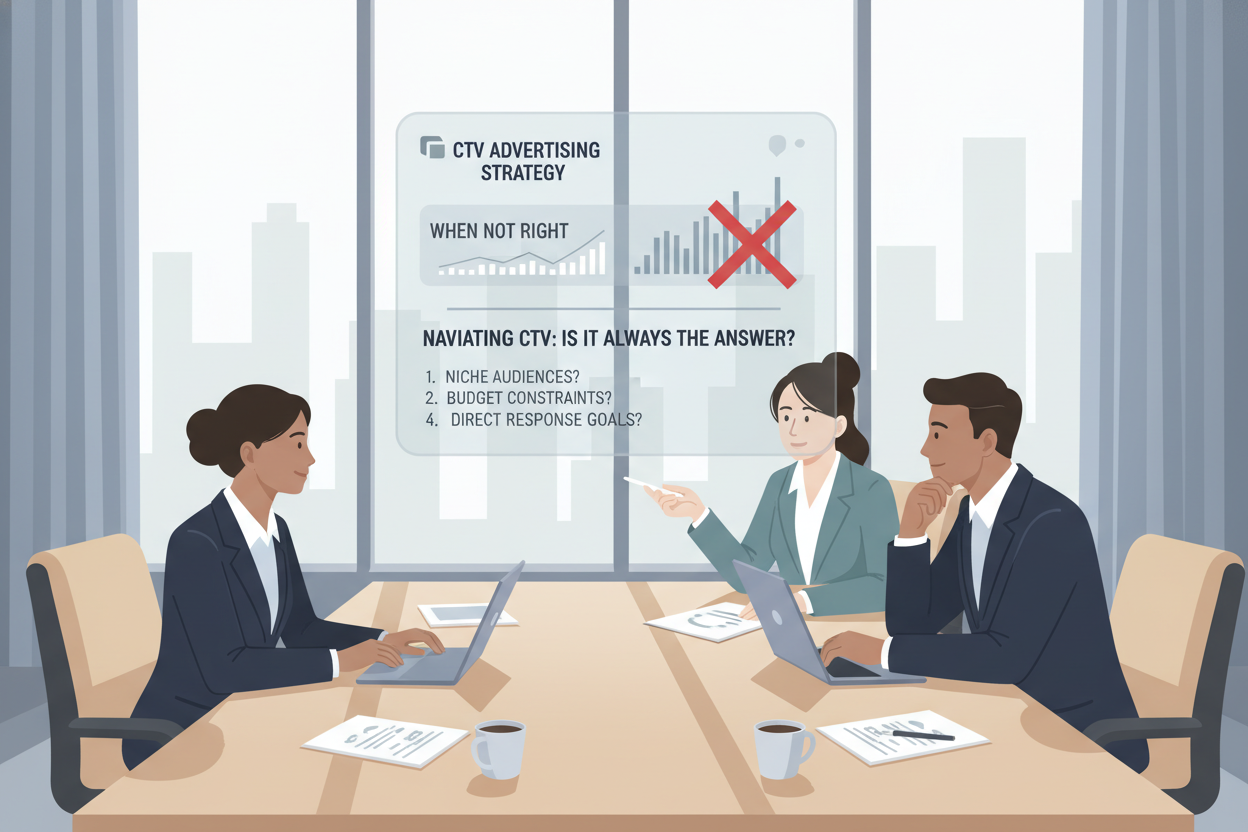
When CTV Isn’t the Right Choice
While I love this medium, ctv advertising isn’t a magic wand for every single brand. It takes a specific strategy to see a real return on your investment. If you jump in too early, you might waste your hard-earned business budget.
You Don’t Have Video Creative
I don’t recommend this approach if you lack high-quality video creative. Viewers expect polished 15 or 30-second spots on their big screens. Basic production usually costs between $5,000 and $15,000. Static images or simple slideshows won’t meet viewer expectations. High-quality ads are essential to keep your business looking professional.
Your Budget Is Too Limited
A limited budget might deliver better results on social media where you can scale gradually. Talk to your platform about whether ctv advertising fits your specific goals at your current level. If your budget is very tight, focusing on search advertising or smaller ads might provide more immediate growth for your brand.
Your Target Audience Is Too Narrow
Very narrow targeting can backfire on streaming platforms. For example, B2B campaigns with lists under 100 accounts often struggle with low match rates. This means your data doesn’t reliably connect to household IP addresses. If your target audience is too small, you won’t generate enough reach to justify the setup effort.
“The best marketing strategy is knowing when to say no to a channel that doesn’t fit your current resources.”
You Can’t Measure Results
If you don’t have website analytics or conversion tracking in place, you are spending blind. You should pause and fix your measurement infrastructure before starting. I believe you shouldn’t launch ctv ads hoping to figure out the tracking later. Clear measurement is the only way to know if your advertising works.
Your Other Channels Aren’t Maxed Out
I tell owners to max out search and social channels first. These platforms capture people who are already looking for your solution. CTV ads create new demand by reaching a wide audience. This strategy only makes sense after you have captured all existing demand from people who are already actively searching for your brand.
| Factor to Consider | Why It Matters | Better Alternative |
|---|---|---|
| No Video Spot | Lowers brand trust | Social display ads |
| Small Budget | Hard to optimize | Search advertising |
| Micro targeting | Low match rates | LinkedIn outreach |
Getting Started with Your First CTV Campaign
Starting with streaming ads might feel intimidating, but I can show you the simple path forward. It is about moving from “what if” to a live spot on the big screen.

Step 1: Define Your Goal
I start every campaign by defining one clear goal. Is this brand awareness, pipeline influence, or direct response?
This choice determines your targeting and measurement approach. Your goals act as a compass for your overall strategy, so don’t skip this foundational decision.
Step 2: Set Your Budget
Talk to your chosen platform about the right test budget for your specific audience. Do not just pick a random number.
I recommend planning for at least 90 days of steady advertising. This ensures your strategy has enough fuel to reach households multiple times without stopping too soon.
Step 3: Get Your Creative Ready
You do not need a massive Hollywood budget to succeed here. At a minimum, you need one 30-second spot and one 15-second cutdown.
The shorter version helps build frequency at a lower cost. High-quality ctv advertising works best when you tell a clear story that speaks to your customer’s needs.
Step 4: Choose a CTV Platform
Different ctv advertising platforms serve different business needs. DTC brands often prefer self-serve platforms with broad advertising reach and direct tracking.
Meanwhile, B2B companies need advertising tools that support account-based reporting. I always pick the tool that matches my specific business model and measurement needs.
Step 5: Run for 90 Days
I always allow time for campaigns to breathe before judging the data. Pulling the plug after two weeks is a costly mistake.
CTV advertising needs 90 days to build frequency and measurable lift. Most successful campaigns deliver results once viewers see your ctv advertising message enough times to trust your brand and take action.
Conclusion
Success with ctv advertising depends on more than just a big budget, as these advertising examples prove. I have shown how brands use streaming to reach new audiences across all devices. The impact of your ctv campaign comes from storytelling and clear messaging. These advertising examples show that creative quality often matters more than perfect target parameters.
To get performance, you must target specific households with enough frequency to drive engagement. Successful ctv campaigns run for 90 days to build awareness and sales. Looking at these advertising examples, it is clear that ads work best alongside other channels. Track data like website visits to see if your ctv advertising is truly effective.
Use these advertising examples to model strategies for better reach and conversion. It is time to target your viewers where they are most attentive. Every example demonstrates that advertising should lead to action. Let these advertising examples guide your next target move and help your ads reach viewers. Use retargeting, see how these advertising examples work, and use these examples to win.
