
Have you ever poured money into ads only to wonder where all your budget went? You’re not alone. Many small business owners feel that way. Let’s cut through the confusion.
In the simplest terms, CPM stands for “cost per mille.” It’s the amount you pay for every one thousand times your advertisement appears on a screen. “Mille” is just a fancy word for a thousand.
This model focuses purely on visibility. An impression counts when your ad loads for a user. It doesn’t require a click. You pay for eyes on your brand.
I use this pricing model often for clients who need awareness. It’s a straightforward way to stretch a tight budget. You know exactly what you’re getting for your money: a set number of views.
Think of it like renting a billboard on a busy street. You pay a fixed fee for the space. You don’t pay extra when people look at it. Your goal is to get your name seen by as many relevant people as possible.
This approach is perfect for building recognition. It fits neatly into a larger marketing plan when immediate sales aren’t the only goal. You gain predictable costs while reaching your target audience.
Key Takeaways
- CPM means “cost per thousand” and refers to the price for 1,000 ad impressions.
- You pay for views, not clicks, making it a model focused on brand exposure.
- It offers predictable budgeting, which is ideal for limited marketing funds.
- This method is highly effective for campaigns aimed at building awareness.
- An impression is counted as soon as your ad loads on a user’s screen.
- It allows you to reach specific audiences with a known, fixed cost.
Understanding CPM in Digital Advertising
Digital advertising thrives on models that prioritize visibility. This pricing method is a cornerstone for many campaigns.
You pay a fixed fee for every one thousand times your ad loads. This approach guarantees your message gets seen.
Definition and Basic Concept
In digital advertising, the model revolves around impressions. Each impression counts when your creative appears.
Programmatic advertising automates the buying process. Your ads reach the ideal audience without manual effort.
This system offers broad reach for advertisers. Publishers gain predictable revenue from it.
Role in Building Brand Awareness
Focusing on exposure is key for brand awareness. Immediate clicks are not the primary goal here.
Repeated views plant your name in customers’ minds. This is especially useful for niche products.
Think about targeting health-conscious shoppers with organic ads. Multiple impressions build recognition over time.
| Advertising Platform | Typical CPM Range | Best For Brand Awareness |
|---|---|---|
| Social Media Feeds | $5 – $10 | Broad audience reach |
| Niche Content Sites | $8 – $15 | Targeted, relevant viewers |
| Programmatic Display | $3 – $7 | Automated, efficient campaigns |
Campaigns for new product launches benefit greatly. You gain visibility before driving direct sales.
This strategy builds a foundation of awareness. Your brand becomes familiar when people are ready to buy.
Explaining what is cost per mille cpm: Basics and Calculation
Understanding the arithmetic helps you compare platforms and spot the best value. It’s the core skill for managing your ad budget effectively.
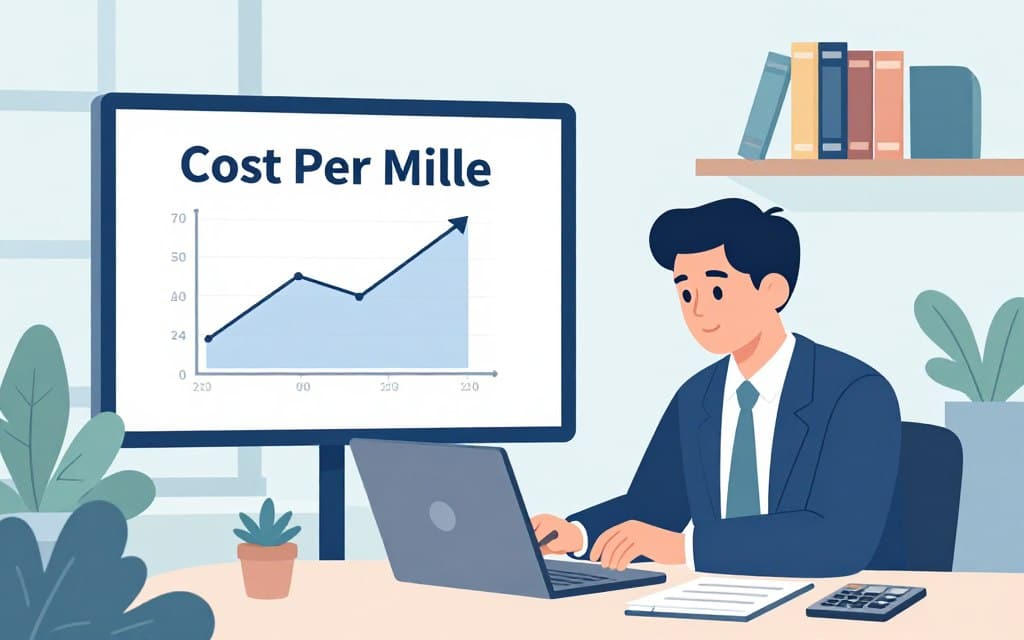
How to Calculate CPM
The formula is simple. Take your total spend. Divide it by your total number of impressions. Then, multiply that result by 1,000.
For example, a $1,500 campaign with 750,000 views works out to $2 for every 1,000 impressions. You now know your exact cost per thousand.
This math matters for two reasons. Advertisers use it to budget. Publishers use it to set prices for their ad space.
You can also calculate backward. If you know the cost per mille rate, you can forecast your potential reach. Track this for every campaign to find the best platforms.
CPM Pricing Models and Variations
Choosing the right pricing structure is crucial for getting real value from your ad spend. Not all platforms charge the same way.
You have options beyond the basic pricing model. Understanding them helps you spend smarter.
Standard CPM and vCPM
The standard model charges you for every loaded ad. A newer pricing model, vCPM, only bills for viewable impressions.
With vCPM, an advertiser pays when at least 50% of the ad shows for one second. Amazon uses this for display ads.
This protects your budget. You avoid paying for ads that load but nobody sees.
Influence of Platform and Seasonality
Rates change wildly by platform. Meta often charges over $7 for 1,000 views. X might cost just $1.20.
TikTok and YouTube sit in the middle. This pricing reflects audience size and targeting power.
Advertisers pay more during busy seasons. In Q4 2024, the average was around $6 per thousand.
Holiday competition drives up costs. Plan campaigns for off-peak times if your budget is tight.
Knowing these models lets you pick the best pricing for your goals.
Benefits and Limitations of CPM
Before you commit your ad dollars, you need a clear picture of both the strengths and weaknesses of your chosen strategy.
Key Advantages for Advertisers
The core benefit is massive brand exposure at a predictable cost. This is perfect for building initial awareness.
I find the pricing model offers several clear wins:
- Transparency: You and the publishers agree on a fixed price for a set number of impressions.
- Lower Cost: Rates are often cheaper than performance models like cost per click.
- Scalability & Comparison: Easily adjust your budget or compare platform efficiency using a single rate.
Potential Challenges and Risks
Impressions do not guarantee clicks or sales. You pay for views, not actions.
Attribution is another hurdle. A customer might see your advertising today but convert weeks later. Proving direct ROI becomes difficult.
Fraud is a real risk. Bots can fake impressions, meaning advertisers pay for phantom views.
You must combine this metric with others like engagement for a full performance picture. It’s wise to compare CPM to CPC to understand which metric serves your goal.
Improving CPM Efficiency in Advertising Campaigns
Getting more from your ad budget means working smarter, not just spending more. I focus on practical tweaks that boost performance without blowing your budget.
Let’s dive into specific strategies that make your campaigns work harder.
Optimizing Targeting and Ad Placement
Sharpen your audience targeting. Reach people who actually care about your products. This lowers your effective cost per impression.
Monitor ad frequency closely. Showing the same ads to someone twenty times wastes money. It also annoys potential customers.
Placement is crucial. Ads at the top of a page or in a social feed perform better. They get more visibility and engagement.
Enhancing Creative and Message Delivery
Invest in eye-catching visuals and compelling copy. Boring creative gets ignored, even with thousands of impressions.
Test different approaches constantly. Run multiple ad versions. Track which gets better engagement. Then put more budget behind the winners.
Use platform-specific tools. On Facebook, improve your relevance score and Customer Feedback Score. This can lower your cpm costs automatically.
Remember seasonality. Pricing often spikes during holidays. Scale back campaigns then unless you have budget to compete.
The flexibility of cpm campaigns is a huge advantage. You can pivot mid-campaign if something isn’t working. This maximizes budget efficiency for advertisers.
CPM in the Context of Digital Marketing Metrics
Let’s put CPM in perspective by comparing it to other common ways you pay for ads. Each pricing model serves a different goal.
CPM versus CPC and CPA
With CPC, or cost per click, you only pay when someone engages. This focuses your budget on interested users visiting your website.
CPA, or cost per action, goes further. The advertiser pays only for a completed sale or sign-up. You pay for results, not just clicks.
| Pricing Model | What You Pay For | Best For |
|---|---|---|
| CPM | 1,000 ad impressions | Brand awareness campaigns |
| CPC | Each click on your ad | Driving website traffic |
| CPA | A specific conversion action | Direct sales and lead generation |
| CPV (Cost Per View) | A user watching your video ad | Video engagement and storytelling |
| CPI (Cost Per Install) | Each app install from an ad | Mobile app user acquisition |
Remember eCPM. It’s a metric publishers use to measure their revenue. Advertisers pay based on the standard cpm rate.
Track your click-through rate alongside your cpm. This shows if your impression-based ads spark interest. Good metrics work together.
Conclusion
Mastering your ad spend requires knowing which pricing model aligns with your campaign goals. You pay a fixed fee for every 1,000 impressions your ads receive. This approach is ideal for building brand awareness.
Focus on exposure, not immediate sales. Calculate your figure by dividing total spend by your number of impressions, then multiply by 1,000.
Rates vary widely. Platform choice, audience, and season all affect pricing. There’s no universal “good” number.
Key benefits include transparent pricing and easy scaling. You can compare different sources quickly. Limitations exist, however. Impressions alone don’t measure engagement or conversions.
This method is just one option in digital advertising. Compare it with CPC and CPA for your marketing objectives. Success comes from continuous testing. Refine your targeting and improve creatives.
Track multiple metrics to gauge true campaign efficiency. This approach ensures your advertising budget works hard for your brand.
