
Peter Drucker, a legendary management thinker, once said, “What gets measured gets managed.” This idea is the bedrock of profitable digital marketing. If you’re not measuring your ad performance, you’re essentially managing in the dark—and that’s a sure way to waste your budget.
I’ve seen it happen too many times. You pour money into campaigns, but the clicks just don’t turn into sales. The hard truth? Globally, about 98% of website visitors leave without buying. That means most of your ad spend might be vanishing without a trace.
This is where a method called split testing becomes your most powerful tool. It’s a controlled way to compare two versions of an ad to see which one people prefer. You make one small change, run both versions, and let the data tell you what improves your click-through rate or conversions.
That knowledge is power. In this field, power turns into a positive return on your investment. I’ll walk you through this process because I’ve helped businesses turn their advertising around. It doesn’t have to be complicated or expensive when you follow a clear path.
Think of this guide as your roadmap. By the end, you’ll know exactly which elements to test and how to read the results. You’ll move from guesswork to confident, data-driven decisions for your business.
Key Takeaways
- Split testing, or A/B testing, is a controlled method to compare different versions of your advertising.
- Without testing, you’re likely wasting a significant portion of your ad budget on clicks that don’t convert.
- The process turns marketing guesses into actionable data that can boost your return on investment.
- You’ll learn a straightforward framework for deciding what to test first in your campaigns.
- Setting up tests properly is key to getting clear, reliable results you can trust.
- Interpreting the data correctly allows you to make profitable decisions and scale what works.
- This approach helps you understand your audience’s actual behavior, not just what you assume they want.
Understanding the Basics of Split Testing
At its core, split testing is about making small, controlled changes to your ads to see what works. It’s a straightforward method that replaces hunches with hard facts. I use it constantly because it removes the guesswork from my marketing decisions.
Defining split testing in digital marketing
In digital marketing, an A/B test means creating two versions of the same ad. You show each one to a similar, random audience group. The goal is to see which variation people prefer.
Each version has just one distinct difference, known as a variable. This could be the headline, image, or call-to-action button. Isolating this single element tells you exactly what caused any change in your results.
Randomization is key. It ensures a fair trial by preventing other factors from skewing your data. I’ve run hundreds of these experiments. The findings often surprise me, proving that my assumptions don’t always match what the audience actually wants.
Benefits for improving ad performance
The benefit here is massive. A well-executed A/B test can increase your return on investment by 10x. You can turn a struggling campaign into a profitable one by altering just one element.
This process gives you reliable data instead of guesses. That information tells you precisely what your customers respond to. You stop wasting money on promotions that don’t convert.
| Approach | Decision Basis | Outcome Clarity | ROI Impact |
|---|---|---|---|
| Traditional Guessing | Gut feeling, assumptions | Unclear why something worked | Often low or negative |
| Data-Driven Split Testing | Concrete performance metrics | Clear cause-and-effect link | Can be significantly positive |
Performance improvements come from this clarity. You learn what resonates and can apply that knowledge across all your marketing efforts. It’s a powerful way to understand your audience’s real behavior.
What Is Split Testing and Why It Matters
Every click that doesn’t convert represents wasted budget, and split testing is how you reclaim that loss. I’ve seen the data: globally, only about 2 out of every 100 visitors make a purchase. That means 98% of your spend might vanish if you don’t optimize your conversion rate.
This process is called conversion rate optimization. It broadens your funnel so more visitors become paying customers.
Key principles behind split testing
The core principle is simple. You measure what people actually do, not what you think they’ll do. You gather this data across all devices your customers use.
You record and compare each ad’s performance based on your campaign goal. This could be clicks, sign-ups, or sales. The principle is fair comparison.
Each version gets shown to a similar audience under the same conditions. This way, you know any difference in results comes from your change, not random luck.
A proper split test turns wasted spend into profit. That’s why I make this a priority for any business owner. It moves you from guessing to knowing.
Core Elements of a Successful Split Test
Successful experiments rely on a simple rule: change only one element per test. If you alter multiple things at once, you won’t know which tweak actually improved your results. This isolation is the foundation of reliable data.
Selecting what to test in your ad campaigns
You must choose variables that directly impact your goal. For instance, don’t compare audience types and delivery methods simultaneously. That creates confusing, unreliable data.
I always advise starting with the elements that deliver the biggest gains. These are the areas where small changes often lead to major performance improvements.
- Ad creative: Your image and post copy are the first things people see.
- Landing page headlines: They determine if a visitor stays or leaves.
- Audience targeting: Demographics like age, gender, and specific interests.
Focus on these core elements first. They control whether someone clicks or converts. Testing takes time, so prioritize what moves the needle.
split testing ads step by step
Let’s walk through the actual mechanics of running an experiment on your promotions. I’ll map this out so you can follow a clear path without feeling overwhelmed.
Mapping Out the Testing Process
You begin by dividing your audience between two versions of your promotion. One is your control—the original. The other is your variable, with just one element changed. You track which one drives more of your desired action.
Your experiment needs to run long enough to gather reliable data, but not so long you waste budget. There are two main types: A/B (one change) and multivariate (multiple changes). I always suggest starting with a simple A/B test.
This process optimizes every stage of your sales funnel. The version with the best results becomes your new control. Then, you apply these best practices for testing ad creatives to your next experiment. It’s a cycle of continuous improvement.
Essential Variables to Test in Ads
Your promotion’s success hinges on which elements you choose to compare. I’ve found that focusing on key areas gives you the biggest performance lift. Let’s break down the most impactful variables.
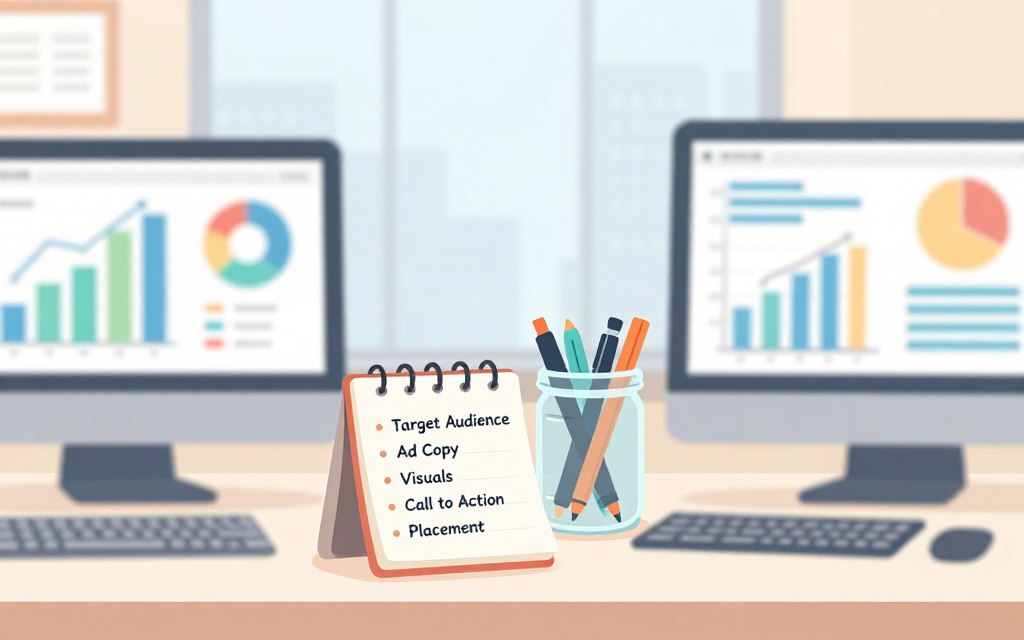
Ad design, copy, and images
Visual choices stop the scroll. Test your headline font, color, and size. Does a colored border make your ad stand out more than a plain white background?
Your copy is equally critical. Compare different headlines and promotional language. Try “Save 20%” against “Save $20” to see what resonates.
Always test images. A compelling product photo often outperforms a lifestyle shot. Your call-to-action button color and text also need testing. “Get Started” might convert better than “Learn More”.
Target audience and placements
Your target audience selection is a major variable. Create separate ad sets for different demographics. Test men versus women, or different age ranges.
Compare interest-based groups and geographic locations. Placement testing is just as important. Should you use automatic placements or manually choose where your ads appear?
Try Facebook Feed versus Instagram Stories. Each platform reaches your audience differently. This test reveals where your message gets the best response.
Structuring Your Ad Campaign for Testing
Before you launch any test, you need to organize your advertising account properly. A clear structure prevents confusion and gives you reliable data. I always map this out first.
Facebook uses a three-layer system. Your campaign holds the overall objective. Inside it, ad sets define budget and audience. Individual ads contain the creative people see.
Organizing campaigns, ad sets, and ads
The ad set level is where you manage your testing. This is because you set budget and targeting parameters there. For a fair test, create separate ad sets for each audience variation.
Imagine you want to compare five images across two genders. Set up one ad set targeting men with a $5 daily budget. Place all five image variations inside it. Create a second ad set for women, also with $5. This keeps your variables organized.
Ensuring fair budget distribution
Budget fairness is critical. The platform’s algorithm can be aggressive. It might spend most of your money on one ad it prefers, starving the others.
That ruins your experiment. For more control, I use an alternative structure. Create a separate ad set for each image with a small, equal budget. Give each one $1 per day.
This guarantees every variation gets a fair chance to perform. Your campaign structure must keep variables isolated. Don’t mix audience and creative tests in one ad set.
Split Testing Landing Pages for Conversions
I often see businesses pour budget into ads, only to lose everything on a poorly performing page. Your landing page is where visitors decide to act. Tweaking this page can create bigger improvements than changing your ads.
I start clients with two completely different designs. Small element changes need thousands of visitors for a clear result. A major redesign often shows a winner much faster.
Evaluating form design and content layout
Form design is critical for conversions. I once ran a test comparing a single-step form to a two-step version. The two-step form asked qualifying questions first. It then asked for personal details.
This simple change resulted in a 420% increase in conversions. Your content layout also needs a test. Try different arrangements of your form, benefits list, and testimonials. Find the sequence that guides people best.
Optimizing the hero section and CTA
The hero section is the first thing people see at the top of your landing page. You must test the headline, subheadline, and image here. This area decides if visitors stay or leave.
Your call-to-action button is the hottest element. Try different button copy, colors, and placement. I use tools like Hotjar to ask visitors what stops them. One client’s visitors said the page felt “not trustworthy.”
We added testimonials and certification logos. This change increased their conversion rate by 30%. Direct feedback tells you exactly what to fix on your landing experience.
Optimizing Your Ad Copy and Call-to-Actions
Your ad copy is the direct conversation you have with potential customers. It decides if people listen or walk away. Getting this right turns interest into action.
Choosing effective CTA buttons and messaging
Start with your headline. It’s often the only thing people read. I test different approaches: stating a fact, asking a question, or addressing a pain point.
Your messaging tone and length matter immensely. For one client’s event, we changed the ad copy from short to story-driven. Purchases jumped from 1 to 92. Cost per acquisition fell 96.72%.
That’s a powerful example of how your content performs. Your call-to-action button must be the hottest element on the page. Test if it stands out against the background.
Is the offer crystal clear? People should know exactly what they get. I always test action buttons versus text-based links. Buttons usually win, but your audience might differ.
Try small wording changes. “Get Started” versus “Start Your Free Trial” can create big differences. Your CTA must communicate value and remove friction.
“Submit” is terrible button copy. “Get My Free Guide” tells people what happens next. This clarity improves click-through rates for your ads.
Use this post as a guide. Test one element at a time. Your copy and CTA work together to drive conversions.
Analyzing Data and Measuring Success
Gathering data is only half the battle; making sense of it is where you win. I see many people get lost in a sea of numbers after their first experiment. The key is to focus on one primary metric that truly matters to your bottom line.
Understanding metrics like conversion rates and ROI
Your conversion rate shows what percentage of clicks turn into customers. Improving this rate means you get more value from the same budget.
ROI, or return on investment, is the ultimate measure. It tells you if you’re making more money than you’re spending. I always track cost per result as my main metric. It shows exactly what I pay for each conversion.
Never analyze performance data too early. Wait until you have enough results to be sure. Jumping to conclusions can make you pick a lucky fluke, not a real winner.
| Primary Metric | What It Tells You | Good For |
|---|---|---|
| Cost per Result | Your actual cost for a lead or sale. | Direct profitability tracking. |
| Conversion Rate | How effective your funnel is. | Optimizing landing pages and offers. |
| Return on Investment (ROI) | Overall campaign profitability. | Big-picture business decisions. |
Also watch secondary data. If your cost per conversion is low but your click-through rate is terrible, your ad creative needs work. This full view makes your testing powerful.
Addressing Common Split Testing Myths
You’ve probably heard the claim that a specific button color will skyrocket your conversions—let’s debunk that right now. I hear a lot of marketing advice that sounds like universal truth, but it’s often just a myth.

Debunking the Button Color Conversion Myth
There is no magical color that guarantees more conversions. What works for one company often fails for another. Your audience is unique.
The impact of color depends entirely on context. Maybe it was the contrast with the page background that drove results, not the hue itself. I’ve seen this firsthand in dozens of campaigns.
If your conversion rate is terrible, a new button color won’t save you. You likely need a better offer or headline. Blindly copying a case study is a poor example of effective split testing.
This thinking applies to other areas, too. There’s no ideal number of form fields for every business. Some audiences will provide detailed info, others abandon short forms.
- The “Magic Button” Myth: No single color works for everyone. Your results depend on your specific page design and audience.
- The “Perfect Form” Myth: The right number of fields is what your motivated visitors will tolerate, not an industry standard.
- The “Copy-Paste” Myth: A tactic that worked in a famous case study is just one example. It may not fit your campaign’s context.
The real lesson is simple. You must test elements for your own audience. Don’t assume a “best practice” will improve your conversion rate. Your split testing should answer your questions, not someone else’s.
Facebook Ads Split Testing Best Practices
Over 10 million ads have been created using advanced testing tools, revealing key patterns for success. I follow a specific framework to make every dollar count.
You should start with broad comparisons before tweaking minor details. This approach saves time and budget.
Strategies for testing ad creative and audiences
Your creative is the first thing people see. Compare different images, video versus static photos, and various calls-to-action.
I’ve seen cost per conversion improvements of more than 100% just from changing an image. This makes creative testing your top priority.
Audience strategies are equally vital. Compare broad groups against narrow ones. Test interest-based targeting versus lookalike audiences.
Different demographic segments like age ranges can perform very differently. One powerful example involved rewriting ad copy.
A client’s first campaign cost $4,433.53 for just one sale. After the rewrite, they achieved 92 purchases at an average cost of $123.45 each.
Leveraging budget and placement insights
Placement testing often reveals cheaper conversion sources. Compare automatic placements against specific ones like Facebook Feed or Instagram Stories.
Your budget insights come from monitoring which ad sets spend efficiently. Redistribute funds toward winners immediately.
Keep underperforming variations running at a minimal spend. This gathers more data without wasting your campaign budget.
This disciplined approach turns insights into profit. It’s the best way to run a Facebook ad campaign.
Advanced Metrics and Statistical Significance
The difference between a guess and a data-driven decision often comes down to one key metric: statistical significance. This tells you if your test results are real or just random luck.
I never make a change without reaching at least 90% confidence. It’s your guardrail against costly mistakes.
Calculating sample size and significance
You need enough people to see each variation to trust the data. Figuring this out manually involves serious math. I use a calculator like Optimizely’s instead.
You input three things. First, your baseline conversion rate. A higher rate means you need fewer visitors.
Second, the minimum detectable effect. This is the smallest improvement you want to find. Setting it at 20% is common.
Interpreting test results accurately
Don’t end your test too early. Each ad variation needs 10 to 20 conversions before you pick a winner.
Fewer than that, and you’re guessing. I’ve seen marketers waste money by stopping early.
A variation winning by 5% with 60% confidence is not a real winner. You need larger differences and higher confidence.
If your baseline conversion is low, under 2%, you’ll need thousands of visitors for reliable results. Patience here saves your budget.
This disciplined approach to testing turns your data into profitable decisions.
Iterative Testing and Campaign Refinement
Your marketing doesn’t end when a test finishes; that’s when the real work of refinement begins. I call this iterative testing. Every time you get results, you use them to make your next move stronger.
How to apply insights for ongoing improvement
Found a winner? Promote that version as your new champion. Then, immediately set up your next test based on what you just learned.
If a specific image style won, test different variations of that style. Did a younger audience convert better? Dive deeper into that age range. Your insights directly shape your next experiment.
I always keep a list of future tests ready. You can never be 100% sure what change will move the needle. Waiting between tests wastes a lot of time and money.
Make sure you document your test results. Patterns emerge over time. Maybe your audience always prefers questions in headlines. These patterns are gold for campaign refinement.
- Promote winners fast: Turn a successful variant into your new control and test against it immediately.
- Learn from every outcome: Even a failed test provides value. It eliminates an option and narrows the path to what works.
- Think long-term: Campaign refinement is a long game. Every experiment teaches you something about your audience.
Don’t get discouraged by a test that doesn’t produce a winner. The eventual success of your testing program will almost always outweigh the cost. It brings you closer to optimal campaign performance.
Integrating Social Proof and User Feedback
I once had a client whose ads were getting clicks, but the landing page wasn’t converting anyone. We used a Hotjar poll to ask visitors questions. The biggest answer was “not trustworthy.”
We added customer testimonials, certification logos, and factory images. The conversion rate jumped by 30%. Social proof adds instant legitimacy.
Using testimonials to boost conversion rates
Quality matters more than quantity. An in-depth testimonial that describes a problem and your solution builds real trust. Always use a full name and a photo.
Anonymous quotes can harm your credibility. You should test different formats. Video testimonials often outperform text because they feel more authentic.
Use tools to gather direct feedback on your pages. This tells you what to test next. Your audience’s answers guide your priorities.
Consider who you’re selling to. Showcase testimonials from similar customers. This grabs their attention and makes your offer relatable.
Run experiments on placement and number. Try one powerful quote versus three scattered throughout the page. Let the data show you what builds the most trust.
Conclusion
Armed with these strategies, you can now make every dollar of your ad budget work harder. You have a complete framework for split testing.
Start simple. Pick one element to change. Make sure you gather enough data for reliable results.
Use tools like Hotjar for feedback. Your platform’s built-in features help too. This creates a lift in your conversion rates.
Remember, what works for another company may not fit your business. Your audience is unique. Test everything for yourself.
This process is a long game. Every experiment teaches you about your customers. The success will outweigh the cost.
Keep a list of future tests. Document your findings. Apply insights to refine your campaigns.
The impact on your marketing can be massive. I’ve seen conversion increases over 400%. These results are possible for you.
