
Your TV screen looks the same, but the path your ad takes to get there has completely changed. Many business owners ask about the core distinction separating traditional broadcast from modern streaming. The answer reshapes how you connect with customers and spend your budget.
Linear television follows a set schedule. Think of classic cable or satellite. Your ad runs when the program airs, and everyone watching sees it. You’re buying a spot in a shared experience.
Connected TV, or CTV, delivers content over the internet. Viewers choose what to watch and when on devices like smart TVs. This allows for precise household targeting instead of broad demographic guesses.
Grasping this shift is crucial. It means your message can find the right people at the right moment, not just a large, general audience. Let’s break down both formats so you can decide where your money works hardest.
Key Takeaways
- Linear TV advertising relies on a fixed broadcast schedule, while CTV offers on-demand viewing.
- CTV enables precise targeting of specific households, unlike linear’s broad audience reach.
- Viewers control their content on CTV platforms, leading to more engaged audiences.
- The choice between formats directly impacts your advertising budget efficiency.
- Understanding these models helps you choose the best strategy for your business goals.
The Evolution of TV Advertising
The journey of television advertising began with a simple timepiece in 1941. For decades after, linear programming ruled. Brands bought spots on cable and satellite networks to reach millions simultaneously.
This model peaked in 2018 with over $70 billion in ad spend. But the numbers now tell a different story. Linear television advertising spending is projected to drop from $60.56 billion in 2024 to $56.83 billion by 2027.
Meanwhile, streaming content consumption keeps climbing. Viewers will watch over three and a half hours of CTV daily by 2026. This represents a massive 31% increase from just a few years prior.
The spending follows the audience. CTV ad budgets grow by double digits annually. They will officially surpass linear TV spending in 2028. In 2024, 40% of marketing professionals moved dollars from traditional to streaming.
This shift doesn’t erase linear TV. Smart brands now use both formats. They reach different audiences at different times. Better data and changing habits continue this evolution.
What is the difference between linear and CTV advertising
The fundamental distinction in television advertising comes down to control—who has it and how it’s used. Traditional linear advertising follows a broadcast schedule set by networks. You watch what they program when they schedule it.
CTV advertising works through internet-connected devices like smart TVs and streaming sticks. Viewers choose their content on their own schedule. This shift changes everything for business owners.
With traditional television, your ad reaches broad audiences simultaneously through cable satellite services. Everyone watching a channel sees your commercial at the same time. It’s a shared experience with limited targeting.
Streaming platforms use household-level data to serve relevant ads. Advertisers can target specific viewers based on their interests and behaviors. This precision makes your budget work smarter.
The difference affects your campaign results directly. Linear reaches many people at once. CTV connects with the right people individually. Choose based on whether you need broad awareness or targeted conversions.
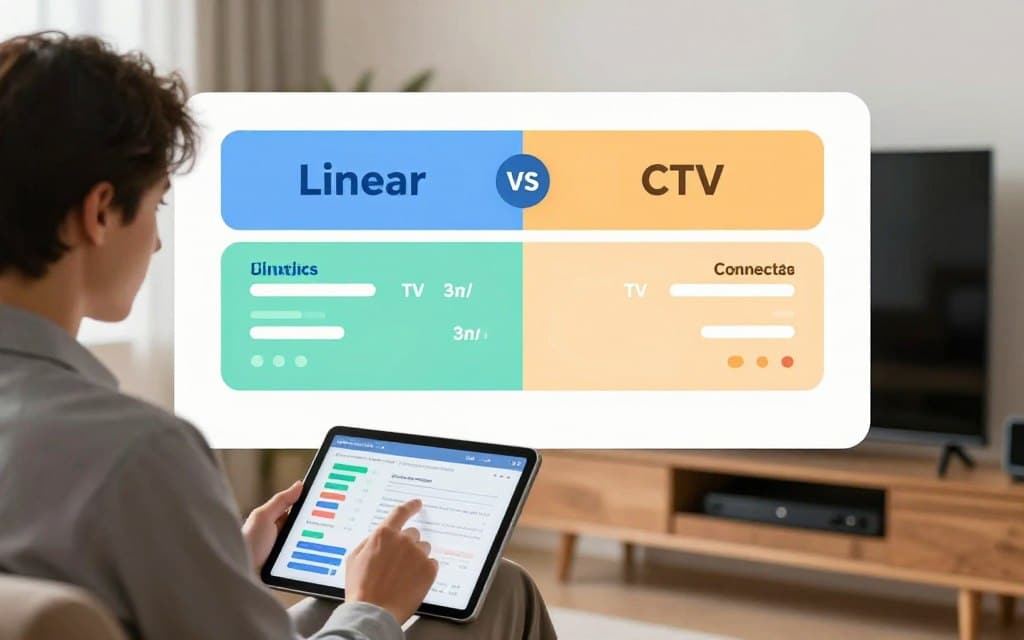
Comparing Audience Targeting: Linear vs. CTV
Your advertising dollars work hardest when they reach the right people, not just the most people. Traditional television casting uses broad demographic nets. Streaming platforms deliver surgical precision to individual households.
Demographic and Behavioral Targeting
Linear TV relies on general age ranges and geographic areas. You buy time slots hoping your message finds interested viewers. This approach reaches many but wastes spend on uninterested audiences.
Connected TV flips this model completely. Platforms use actual viewing habits and online behavior for targeting. Your ads reach people based on what they genuinely watch and enjoy.
This behavioral approach means better engagement. Viewers see relevant messages that match their interests. You connect with people more likely to care about your offering.
Household-Level Data Integration
CTV platforms integrate first-party data for unprecedented precision. Advertisers can target specific households using customer lists. You can even exclude existing customers from seeing certain ads.
This household-level control reduces wasted spending dramatically. Your budget focuses only on high-potential viewers. The targeting capabilities transform how efficiently your money works.
For brands with limited budgets, this precision delivers superior results. You achieve more impact with fewer dollars. The targeting difference represents a fundamental shift in advertising effectiveness.
Measurement and Reporting in TV Advertising
Knowing exactly how your ads perform separates guessing from strategic spending. The measurement approach you choose directly impacts your campaign’s success.
Traditional Ratings vs. Real-Time Analytics
Traditional television relies on Nielsen ratings for performance tracking. These estimates use panel data to guess viewer numbers. You receive reports weeks after your ads air.
This delayed data makes real-time adjustments impossible. You cannot optimize your campaign while it runs. The system works for broad awareness but lacks precision.
Connected platforms flip this model completely. They deliver instant analytics showing exactly how viewers engage. You see metrics like completion rates and view-through conversions.
This real-time measurement lets you tweak campaigns immediately. You can allocate budget to better-performing ads. The system provides transparent results advertisers trust.
CTV achieved a 93.2% viewability rate in 2022. This means almost every ad served was actually seen. Such precise data helps brands justify their spending confidently.
Ad Inventory, Control, and Cost Considerations
Your budget allocation strategy needs to match how ads actually get purchased in today’s TV landscape. Traditional television requires direct network deals with upfront commitments. You lock into fixed time slots with little flexibility once your campaign launches.
These rigid agreements often demand minimum spends reaching tens of thousands of dollars. Many smaller brands simply cannot access this inventory. You commit to specific programs and time periods without real optimization options.
Streaming platforms operate completely differently. They offer programmatic buying with flexible budget options. You can start small and scale your campaign based on actual performance data.
CTV gives you control over frequency capping to avoid household oversaturation. While CPM rates range from $15 to $30, the targeting precision reduces wasted spend dramatically. Your money works harder reaching interested viewers.
Linear television viewers typically see about 15 minutes of ads per hour. Streaming platforms show only 1 to 9 minutes hourly. This lower ad load means less competition for viewer attention.
Traditional slots still deliver excellent value for massive reach campaigns. But for performance-focused advertisers with limited budgets, CTV platforms provide superior cost control and real-time optimization capabilities.
Viewing Experience and User Control
Television viewing habits have shifted from passive consumption to active participation. This change transforms how audiences engage with your message.
Fixed Scheduling and Live Programming
Traditional television follows a strict timeline. Viewers adapt their schedules to match channel programming. This format works best for live events.
Major sporting events like the Super Bowl demonstrate this power. Over 126 million viewers watched Super Bowl LIX through traditional broadcasts. Only 22.3% streamed it digitally.
Commercial breaks occur at predetermined times. Viewers cannot skip these ads without special recording equipment. This creates shared viewing moments across massive audiences.

On-Demand, Interactive, and Streaming Features
Streaming platforms flip the control dynamic completely. Viewers choose what to watch and when. They pause, restart, or continue content later.
This flexibility changes the advertising experience. Ads deliver based on viewer profiles, not just time slots. Some formats even support interactive elements.
“Modern viewers expect control over their entertainment. They want to watch what they want, when they want it.”
| Aspect | Traditional Viewing | Streaming Experience |
|---|---|---|
| Schedule Control | Fixed by network | Determined by viewer |
| Content Access | Live only | On-demand available |
| Ad Timing | Predetermined breaks | Dynamic placement |
| Viewer Interaction | Passive watching | Active participation |
Interactive ads let viewers click for more information without leaving their screen. This creates engagement beyond traditional commercial breaks. Your message reaches people when they’re most receptive.
Understanding these viewing differences helps craft effective campaigns. Each format serves distinct purposes in your marketing strategy.
Complementary Roles of Linear TV and CTV in Campaigns
Smart advertisers don’t choose between television formats—they use both to maximize their impact. Your campaigns work better when linear and streaming platforms complement each other.
Viewing data reveals three distinct audience segments. About 12% of consumers only watch traditional television. Another 18% exclusively stream their content. The majority—70%—watch both formats regularly.
Ignoring either channel means missing significant audience segments. Brands that combine approaches achieve 32% greater reach than linear-only campaigns. This incremental reach delivers more value for your advertising budget.
Linear advertising provides unmatched mass reach for brand building. It quickly delivers your message to millions simultaneously. CTV advertising adds precision targeting and performance measurement capabilities.
Combining both formats enables better frequency management across platforms. You avoid oversaturating the same audiences with too many ads. This approach also supports holistic cross-channel attribution.
For most advertisers, the smartest strategy uses both channels. This covers all your bases and reaches audiences wherever they watch content. Platforms like YouTube TV make streaming integration accessible for businesses of any size.
The complementary approach optimizes your budget allocation while maximizing engagement. You get the broad awareness of linear with the targeted performance of streaming.
Strategic Considerations for Advertisers in the US
The most successful advertisers approach television as an ecosystem rather than separate options. Your advertising strategies should blend formats to maximize impact.
Nearly half of marketers consider both formats equally valuable. This shows you need integrated campaigns that work together.
Integrated Campaign Planning
Start with your objectives, not channels. Decide what you want to accomplish first. Then choose platforms that support your goals.
Use linear advertising for broad brand awareness. It reaches millions quickly across the country. Layer CTV for precision targeting and repeated engagement.
| Approach | Integrated Campaign | Siloed Strategy |
|---|---|---|
| Measurement | Unified framework | Separate tracking |
| Audience Reach | 32% greater coverage | Limited segments |
| Budget Efficiency | Optimized spending | Potential waste |
| Performance Insight | Holistic view | Channel isolation |
Employ suppression tactics to avoid showing ads to the same households multiple times. This prevents audience fatigue and saves money.
Modern platforms offer the flexibility to run coordinated campaigns. Small brands can maximize reach without doubling costs. Integrated planning delivers better performance across all metrics.
Conclusion
Modern viewers see all television as one seamless experience, and your strategy should reflect that. The lines between traditional and streaming formats continue to blur.
Smart business owners leverage both approaches for maximum impact. You get the broad reach of traditional television combined with the targeted precision of streaming platforms.
This integrated approach delivers better engagement and stronger campaign results. Your advertising dollars work smarter when you match the format to your specific goals.
Start by understanding where your target audience spends their viewing time. Then allocate your budget across the channels that reach them most effectively.
The future of television advertising isn’t about choosing sides. It’s about using all available tools in the smartest way possible to grow your business.
