
Did you know most small business ads get clicked by less than 2% of people who see them? That means 98 out of every 100 viewers scroll right past. Your hard-earned budget vanishes without a trace.
Your CTR is that critical percentage. It’s the number of people who act after seeing your promotion. This metric tells you if your message truly connects.
I’ve watched countless entrepreneurs burn through cash with poor results. The root cause is often a weak click-through rate that goes unnoticed. This number is the most honest feedback you’ll ever get.
You don’t need expensive consultants. I’ll show you practical ways to boost your CTR quickly. These strategies work on Google Ads, social media, and email campaigns.
This guide delivers real steps. You’ll learn why promotions fail to attract clicks. I’ll share industry benchmarks and immediate actions you can take. I’ve helped businesses double their performance with simple tweaks.
By the end, you’ll know how to diagnose issues and improve your click-through rate. Get more value from every advertising dollar you spend.
Key Takeaways
- Your CTR is a direct measure of your ad’s appeal and connection with the audience.
- A low CTR silently wastes your advertising budget and reduces campaign efficiency.
- Simple, actionable changes can significantly improve your click-through performance.
- Effective strategies apply across different platforms like search, social, and email.
- Understanding your industry’s CTR benchmarks helps set realistic goals.
- You can diagnose and address CTR problems yourself without large agency fees.
- Improving this metric directly boosts your return on investment for every campaign.
Understanding Click-Through Rate Basics
I often start by asking clients one question: what percentage of viewers actually engage with your promotions? That number is your click-through rate. It’s the most honest signal you have.
CTR Definition and Calculation
CTR is a simple ratio. You take your total clicks and divide them by your total impressions. Multiply by 100 to get a percentage.
This metric shows immediate audience interest. A high CTR means your message resonates. People see it and want to learn more.
Real Impact on Campaign Success
Your CTR directly affects your costs. Platforms like Google Ads reward a strong rate with a better Quality Score.
A higher score lowers your cost per click. It also improves your ad position. This turns your budget into more valuable traffic.
Think of it as your campaign’s foundation. Good marketing starts with getting the click. Everything else depends on that first step.
Industry Benchmarks and What Constitutes a Good CTR
Let’s cut through the confusion: a ‘good’ CTR changes based on where and what you’re promoting. I’ve watched clients celebrate a 2% rate on one platform while missing huge opportunities on another.
Your performance goals must match reality. Comparing your display ad numbers to search campaign results will only frustrate you.
Channel Comparisons and Expectations
Each marketing channel has its own rules. For example, Google Ads search campaigns often achieve a 3-5% CTR. Display ads on the same network average just 0.5-1%.
Email marketing typically sees 2-3% across industries. SMS marketing crushes this with a stunning 19% average. That’s why I recommend SMS for urgent offers.
Social media platforms vary widely. Facebook advertising averages about 1.1%. LinkedIn campaigns usually see rates near 0.4%.
Use this table to set realistic expectations:
| Marketing Channel | Typical CTR Range | Key Insight |
|---|---|---|
| Google Ads (Search) | 3-5% | Strong user intent drives higher engagement. |
| Google Ads (Display) | 0.5-1% | Broad awareness plays; lower clicks are normal. |
| Email Marketing | 2-3% | Nonprofit and government sectors often exceed 4%. |
| SMS Marketing | ~19% | Exceptional for time-sensitive promotions. |
| Facebook Advertising | ~1.1% | Visual and social context influences clicks. |
| LinkedIn Campaigns | ~0.4% | Professional audience, more considered clicks. |
Your industry also shapes these numbers. B2B advertising averages 2.4% CTR. Real estate often hits 3.7%. Dating services can reach 6.1%.
Always measure your results against industry-specific data. Tools like Google Analytics benchmarking provide this context.
Common Causes of Low Click Through Rate in Ads
The root of a disappointing CTR often lies in a few common mistakes. I see businesses make them every day. Your budget drains because people see your promotions but don’t act.
Let’s break down the two biggest culprits. Understanding these issues is the first step toward a stronger performance.
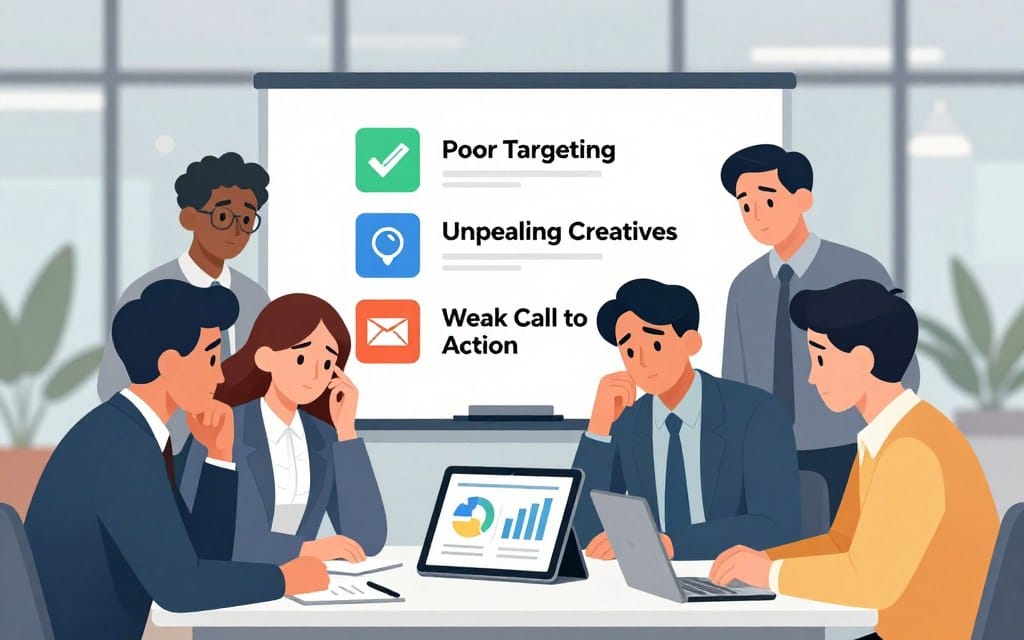
Poor Targeting and Irrelevant Audiences
Your ads fail when they reach the wrong people. Casting a wide net is a classic error. Targeting “all adults 25-65” ignores specific interests and purchase intent.
This lack of relevance kills engagement. Your message gets lost in the noise. People simply scroll past.
Placement matters just as much. Showing luxury offers on bargain-hunting sites wastes money. Your audience must be in the right mindset to care.
Weak Messaging and Creative Flaws
Confusing copy is a silent killer. If people don’t instantly grasp your offer, they won’t click. Your headline and image must work together.
Blurry visuals and cluttered designs make eyes glaze over. Stock photos blend into the background. Your creative needs to stand out and connect emotionally.
Ad fatigue is another major factor. Seeing the same promotion repeatedly causes mental tuning-out. Refreshing your creative is non-negotiable for sustained CTR.
Diagnosing these areas is crucial. I always check who sees the ads, what they say, how they look, and where they appear. You can calculate and improve your CTR by addressing these core issues first.
Practical Strategies for Audience Targeting
Stop guessing who might be interested. Let your data tell you who actually is.
Smart targeting puts your message in front of the right people. It turns wasted impressions into valuable engagements.
Data-Driven Segmentation Techniques
Forget broad demographics. Segment your audience based on real behavior.
Look at who visited specific product pages. Identify users who added items to a cart but left. These behavioral signals are gold.
I always start with retargeting campaigns. People familiar with your brand are five to ten times more likely to engage.
Use platforms’ in-market audience features. These target individuals actively searching for solutions like yours right now.
Here is a simple framework to organize your approach:
| Segment Type | Definition | Targeting Action |
|---|---|---|
| Cold Audience | New users with no prior brand interaction. | Use interest-based targeting for broad awareness campaigns. |
| Warm Audience | Visitors who browsed your site or content. | Implement retargeting with educational or nurturing messages. |
| Hot Audience | Users who showed clear intent, like cart abandoners. | Serve direct-response ads with strong offers and urgency. |
Exclusion is just as powerful. Regularly review campaign data. Block demographics or placements that consistently underperform.
Double down on what works. Find your golden segments and allocate more budget there.
This disciplined approach makes every dollar work harder for your business.
Enhancing Ad Copy and Creative Elements
The difference between a scroll and a click often comes down to two things: words and pictures. Your copy and creative must work in perfect harmony.
They form a one-second pitch to your audience. Get this right, and you’ll see a dramatic shift in engagement.
Crafting Compelling Headlines
Your headline is your first and most important impression. I write headlines that lead with a specific, desirable benefit.
Instead of “Improve Marketing,” try “Cut Your Ad Costs by 40%.” This tells people exactly what they gain.
Numbers and questions are my secret weapons. “7 Ways to Boost Engagement” performs better than a vague title.
A question like “Struggling with Poor Results?” directly engages the reader’s brain. Personalize it with “you” for even more impact.
Your call-to-action must have urgency and clarity. “Claim Your 50% Discount Today” outperforms a weak “Learn More.”
| Headline Type | Key Trait | Example CTA |
|---|---|---|
| Benefit-Driven | Focuses on the user’s gain. | “Save 5 Hours Per Week Now” |
| Question-Based | Engages curiosity. | “Get Your Free Guide Now” |
| Numbered List | Sets clear expectations. | “See 3 Proven Methods in 30 Secs” |
| Urgency-Driven | Creates time pressure. | “Claim Exclusive Discount Today” |
Using Visuals to Boost Engagement
Your image must stop the scroll. Use high-resolution photos with bold colors and strong contrast.
Avoid cluttered layouts. The main subject—your product, a person, or a key benefit—should be immediately obvious.
Brand consistency is non-negotiable for trust. Your ad’s design should mirror your landing page.
This visual continuity makes people feel secure. They won’t suspect a scam when they arrive.
Great creative tells a story at a glance. It makes an emotional promise that your copy then seals.
Leveraging A/B Testing and Data Analysis
The secret to higher engagement lies in systematic testing, not guesswork. I treat every promotion as a live experiment.
Your data reveals what truly resonates with people. This approach is vital for your ads and email campaigns.
Testing Variations to Identify Winners
Start by changing one element at a time. Run two versions with different headlines but identical images.
This tells you exactly what caused a shift in your CTR. Headlines have the biggest impact, then your call-to-action.
Wait for at least 100 clicks per variation before deciding. Small sample sizes lead to false results.
I set up automated reports in Google Ads. They email me weekly performance data so I can spot drops fast.
Here’s a real example. I tested “Save Money on Ads” versus “Cut Your Ad Costs by 40%”. The specific number version got 2.3x higher click-through rate.
Document every test in a spreadsheet. Note what changed, the results, and what you learned.
Build a knowledge base of what works for your audience. Never stop testing.
Create new variations to beat your current best performer. CTR naturally declines over time due to ad fatigue.
Use ad rotation settings to split traffic evenly. Let tests run for a full week to account for daily differences.
This continuous optimization makes your budget more effective. Your campaigns will deliver stronger results consistently.
Optimizing Placements for Better Engagement
A brilliant message can fail completely if it’s shown in the wrong place. Your ads need the right environment to spark action.
Context shapes engagement. People ignore promotions that feel out of place.
Improving Contextual Relevance
Match your ads to related content topics. This is called contextual targeting.
Show accounting software display promotions on finance blogs. Avoid random entertainment sites where your audience isn’t thinking about work.
Review placement reports every month. Exclude websites or apps that get many impressions but zero clicks. This protects your budget and boosts quality traffic.
I’ve seen display campaign performance jump 60% by limiting placements to specific, high-quality sites. Don’t let automatic settings spray your ads everywhere.
Use programmatic solutions in platforms like Google Display Network. Set automated bidding to “Maximize Conversions.” Let algorithms find the best placements, then refine based on your data.
Your landing page must mirror your ad’s promise. A mismatch destroys trust and wastes the click.
If your promotion offers “50% Off Running Shoes,” the landing page should show that exact deal front and center. Consistency is non-negotiable.
Place a clear call-to-action button above the fold. Use text like “Download Now” or “Start Free Trial.” Don’t make the user hunt for the next step.
Over 70% of display traffic comes from mobile devices. A slow or broken mobile page kills engagement instantly.
Optimize for speed and responsiveness. This simple step protects your investment and keeps your audience moving forward.
Dynamic Retargeting and Personalized Ads
Imagine showing an ad for the exact product someone just viewed on your site. This is dynamic retargeting. It works because you’re re-engaging warm audience segments.
These campaigns target users with prior brand interaction. Your CTR often doubles or triples. People already know you, so they click more.
Implementing Predictive Retargeting Approaches
Start by creating separate audience lists. Segment people who viewed specific product pages. Group those who abandoned their cart.
Show these users ads specifically about what they saw. Dynamic creative optimization automates this. It pulls the viewed item directly into the ad creative.
Lookalike audiences find new people similar to your best customers. Platforms analyze your converters. They find users with matching behaviors.
This table organizes your core retargeting strategy:
| Audience Type | Definition | Best Ad Approach |
|---|---|---|
| Product Viewers | Users who browsed specific items. | Dynamic ads showing those exact products. |
| Cart Abandoners | Visitors who added items but didn’t buy. | Ads with urgency and a direct offer. |
| Engaged Visitors | People who spent 2+ minutes on site. | Educational or brand-nurturing content. |
| Lookalike Audience | New users similar to your converters. | Broad top-funnel offers to introduce your brand. |
Time your retargeting campaigns carefully. I wait 24 hours after a site visit. Then increase ad frequency over the next two weeks.
Location-based personalization is powerful for local businesses. Tailor your message for cities or weather conditions. This boosts CTR through immediate relevance.
Create segment-specific copy for different buyer personas. Budget shoppers want deals. Premium customers value service. Home retailer 4Home used lookalike audiences for retargeting. They drove an 800% increase in return on ad spend.
Personalized targeting makes every impression count. Your CTR will reflect that effort.
Step-by-Step Guide: How to Fix Low Click Through Rate in Ads
Follow this proven five-step process to immediately boost your campaign’s click-through rate. I use this exact framework when I need to rescue underperforming promotions. It turns confusion into clear action.
Practical Fixes and Actionable Steps
Start by gathering your last 30 days of campaign data. You need a clear baseline before making changes. This table outlines the core actions you will take.
| Step | Primary Action | Key Focus Area |
|---|---|---|
| 1 | Refine Audience Targeting | Double down on high-performing segments; exclude irrelevant placements. |
| 2 | Improve Ad Copy | Craft benefit-driven headlines and urgent calls-to-action. |
| 3 | Upgrade Creatives | Use high-resolution visuals that match your landing page design. |
| 4 | Optimize Placement | Use contextual targeting and block sites with zero clicks. |
| 5 | Test and Iterate | Run A/B tests on headlines, images, and CTAs systematically. |
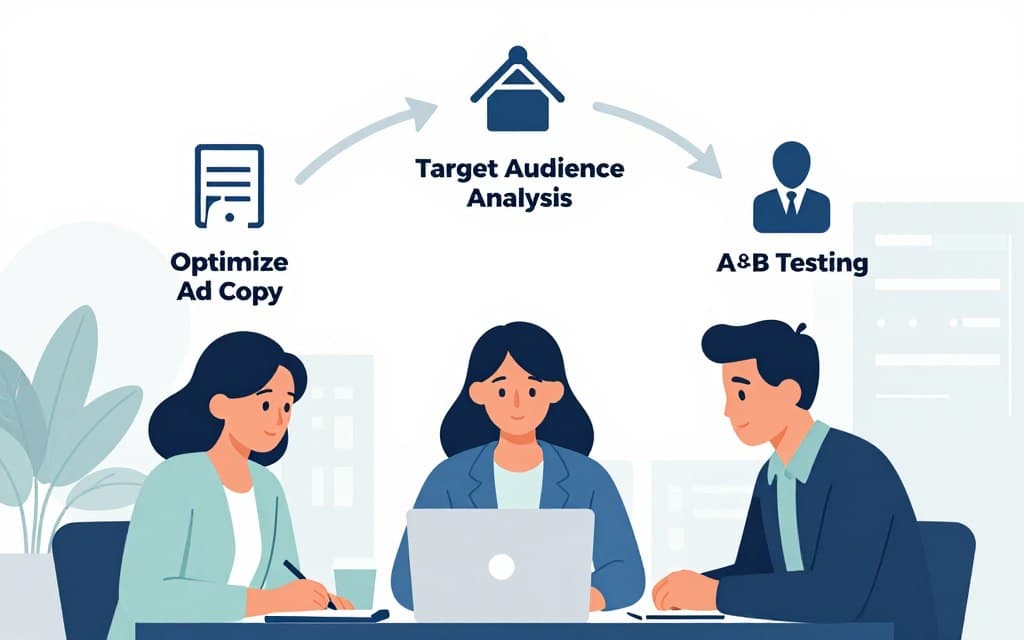
First, refine your audience. Pull your data and identify which segments drive the most clicks. Pause spend on underperformers and focus your budget on these winners.
Next, audit your copy. Is your headline specific? Does your call-to-action create urgency? Rewrite weak lines using the formulas I shared earlier.
Your creative elements must stop the scroll. Invest in clear, high-contrast images. Ensure your ad’s design flows seamlessly to your landing page for a cohesive user experience.
For placement, download your placement report. Exclude any website with over 100 impressions and zero clicks. This protects your budget instantly.
Finally, commit to continuous testing. Launch A/B tests on your best ads. Change one element at a time and measure the CTR impact after 100 clicks per variant.
Track your quality score in Google Ads. Improving your CTR raises this score, lowering your costs. Document your baseline and measure again in two weeks. I typically see improvements of 30% or more.
Tools and Techniques to Monitor and Improve CTR
Monitoring your campaign’s performance in real-time transforms guesswork into actionable strategy. The right tools turn raw numbers into a clear roadmap.
I rely on a core set of metrics alongside CTR. Track cost per click, conversion rate, and Quality Score. This gives you the complete story of your ad performance.
Using Real-Time Analytics for Better Insights
Set up custom dashboards in Google Analytics. View CTR by device, location, and time of day. Spot patterns like mobile users clicking more than desktop.
Establish a weekly reporting cadence for active campaigns. Compare your data against industry benchmarks and your own history. This reveals true trends.
Automate alerts for significant changes. Get notified if your click-through rates drop or cost per click spikes. Respond in real time instead of weeks later.
Watch for invalid traffic. A sudden CTR spike with flat conversions often means bot clicks. This fraud wastes your spend and skews results.
Use tools like Google Ads Editor for bulk changes. Track CTR trends in a simple spreadsheet. Measure ad results from impression to revenue for full-funnel insight.
Conclusion
Armed with these strategies, you’re ready to transform your advertising results. You now have the benchmarks, diagnostics, and step-by-step fixes to elevate your campaign performance.
Remember, a higher CTR means more than extra clicks. It directly lowers your cost per click, boosts your Quality Score in Google Ads, and makes every dollar of spend work harder. This leads to better conversion rates and more revenue for your business.
Start with your biggest opportunities. Refine your target audience, rewrite weak ad copy, and upgrade tired creative. Test one change at a time to see what works. Monitor your CTR weekly against benchmarks.
Watch for fraudulent traffic that inflates click-through rates without real user engagement. Protect your marketing investment.
These principles work across search, display, social, and email. I’ve seen businesses double their CTR and transform their results. Pick one campaign today. Apply these fixes and measure your progress in two weeks.
